

Not every basketball feels the same.
Pick up two balls that look almost identical and you may notice the difference right away. One feels softer in your hands. Another has a better grip. Some work well on an indoor court but don't hold up as nicely when they're being used outside.
Then there are the little things people don't always think about - size, surface material, how often the ball will be used, and even where it will be stored.
If you're buying basketballs for a team, club, school, sports shop or your own brand, these details are worth looking at before choosing a model.
Start With Where the Ball Will Be Used
The first question is a simple one:
Where are people actually going to play?
Indoor basketball courts usually have smooth wooden or synthetic floors. Outdoor courts are a different story. Concrete and asphalt are harder on the surface of a basketball, especially when the ball is being used regularly.
For indoor play, players often pay more attention to how the cover feels in the hand. Grip and touch become particularly noticeable during passing, shooting and dribbling.
Outdoor basketballs generally need to deal with more wear.
That doesn't mean one ball can only be used indoors or outdoors. Plenty of basketballs are made for both. It's just worth thinking about the court before choosing the cover material.
Size Matters More Than You Might Think
Basketballs come in different sizes, and the right one depends largely on who is using it.
Size 7 is the standard adult men's basketball and is commonly used for high-school, college and men's games.
Size 6 is commonly used for women's basketball and younger players.
Smaller sizes are available for children and training.
If you're buying for a club or team, this part is usually straightforward. If you're creating a retail product or a custom basketball collection, however, offering different sizes can make the range much more useful.
There isn't much point in making a great-looking basketball if the size doesn't match the people you're selling it to.
The Cover Changes the Feel
The outside of the basketball is one of the biggest differences you'll notice when comparing models.
Rubber basketballs are common for outdoor play. They're generally built with everyday court use in mind and can handle rougher surfaces.
PU and composite leather basketballs have a different feel.
They are often chosen when players want a softer touch and more control in the hand. Microfiber and other synthetic leather surfaces can also be developed with different textures, depending on the intended use.
This is where the playing environment matters again.
A cover that feels great on a clean indoor court may not be the first choice for someone spending most weekends playing on an outdoor concrete court.
Grip Isn't Just About Being Sticky
When people talk about basketball grip, they sometimes mean one thing: how sticky the surface feels.
In reality, it's a little more complicated.
You want the ball to stay comfortable in your hands without feeling strange when you move it quickly between your hands.
Texture matters. So does the surface finish.
Sweat makes a difference too. During a long practice session, the feel of the ball can change compared with the first few minutes of play.
For that reason, grip is something that's better judged by actually handling the basketball rather than looking at a product photo.
Think About How Often It Will Be Used
A basketball for occasional backyard games doesn't necessarily need the same construction as one that will be used every day for training.
If a club has several training sessions every week, the ball will see a lot more contact with the court.
The same is true for schools, sports camps and rental programs.
For regular use, surface durability becomes more important. You also want a ball that keeps its shape and playing feel reasonably well over time.
For casual users, appearance and price may play a bigger role.
There isn't one perfect basketball for everyone.
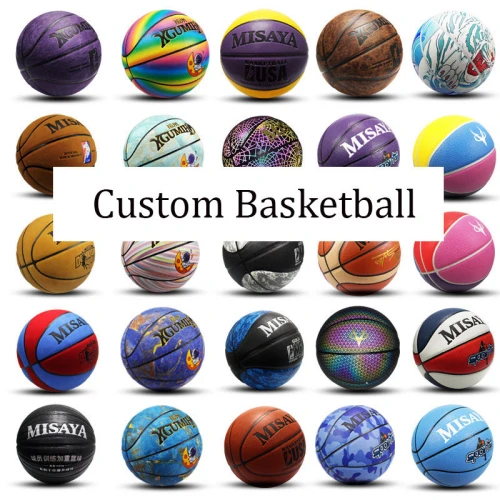
What About Custom Basketballs?
Custom basketballs are no longer limited to professional teams.
Schools, youth clubs, sports retailers, event organizers and brands can all use custom designs for different reasons.
Sometimes it's simply a logo.
Other times the entire surface is designed around a team color, mascot, artwork or a new brand identity.
With custom basketballs, there are usually several things to decide before production:
Basketball size
Cover material
Surface texture
Main colors
Logo placement
Printed pattern
Valve and construction details
Packaging
Quantity
The artwork itself is only one part of the process.
A design that looks good on a computer screen still needs to work on a curved basketball surface. Small details, color combinations and logo placement can look different once they're printed and assembled.
It's worth checking the artwork carefully before production starts.
A Simple Logo Can Work Better Than a Busy Design
More graphics don't always make a better basketball.
If the ball is going to be used by a team or sold under a brand, the logo should usually be easy to recognize from a distance.
Large areas of color can also make the ball look cleaner than a design packed with small details.
That doesn't mean custom basketballs have to be plain.
A well-designed pattern can make a basketball stand out, particularly for lifestyle brands, promotional products or limited-edition collections.
The important part is knowing what the ball is supposed to look like once it's actually in someone's hands.
Don't Forget the Basketball's Intended Customer
A basketball designed for a professional training environment may not be the same product you'd choose for a children's sports program.
A retail basketball may need attractive packaging and strong visual branding.
A school or club may care more about durability and consistent performance across a larger order.
And if you're developing a new sports brand, you may want the basketball to match the look and feel of the rest of your product range.
The ball itself is only part of the decision.
Who is going to use it should come first.
If You're Ordering Custom Basketballs, Ask for a Sample
This is probably the easiest way to avoid surprises.
Photos can show the color and overall design, but they can't tell you exactly how the ball feels in your hands.
If you're developing a new custom basketball, check the sample for:
Surface feel
Grip
Printing quality
Logo position
Color accuracy
Shape
Air retention
Overall finish
If possible, actually take it onto a court.
Dribble it.
Shoot with it.
Pass it around.
A few minutes of real use can tell you more than a long product specification sheet.
One Basketball Doesn't Have to Fit Every Situation
There are plenty of good basketballs on the market, but the right choice depends on how the ball will be used.
For outdoor recreational play, a durable surface may matter most.
For indoor training, players may pay more attention to touch and grip.
For a custom brand, appearance, material, size and packaging all become part of the product.
That's why choosing a basketball isn't simply about finding one with the right size or the lowest price.
Think about the court.
Think about the player.
Think about how often the ball will be used.
And if you're creating a custom basketball, test the actual sample before committing to a larger production run.
A basketball spends most of its life being handled, bounced, passed and shot.
It should feel right when it does.


